Protein is essential, but it isn't free. It costs money and puts a real load on your organs, which is why your goal should be to consume just enough for your goals, not as much as possible.
You've probably heard the common recommendations. Current evidence points to 1.2–2.0 grams of protein per kilogram of body weight as plenty for most active people. You might also hear specific rules, like Jeff Nippard's suggestion of 1 gram of protein per centimeter of height or the old gym standby of 2 grams per kilogram for building a better physique.
But it's not quite that simple.
Those rules are a decent starting point, but they miss the critical details. Your actual protein needs change constantly depending on the context. Here’s a perfect example that might sound backward at first: Ronnie Coleman, during a bulking phase, could actually require less protein per kilogram of lean mass than an average person who's trying to lose weight in a calorie deficit.
When you dig into the research papers, you'll notice they always give a range for protein intake, not a single magic number. The real challenge is figuring out exactly where you fall within that recommended range.
Several key factors determine your specific protein needs:
- How hard and how often you're training.
- Whether you're in a calorie surplus to gain weight or a deficit to lose it.
- Your current body fat percentage.
- Your Fat-Free Mass Index (FFMI), which accounts for your lean mass relative to your height.
Simple rules like 1.6-2.2 g/kg or 1 g/cm of height are fine for a general idea, but you have to remember that your protein requirement is dynamic. For a much more accurate approach, it's better to base your intake on your lean body mass instead of your total body weight when body fat is higher, calories are lower, or muscle retention is the priority.
Bodyweight (BW) or FFM or LBM
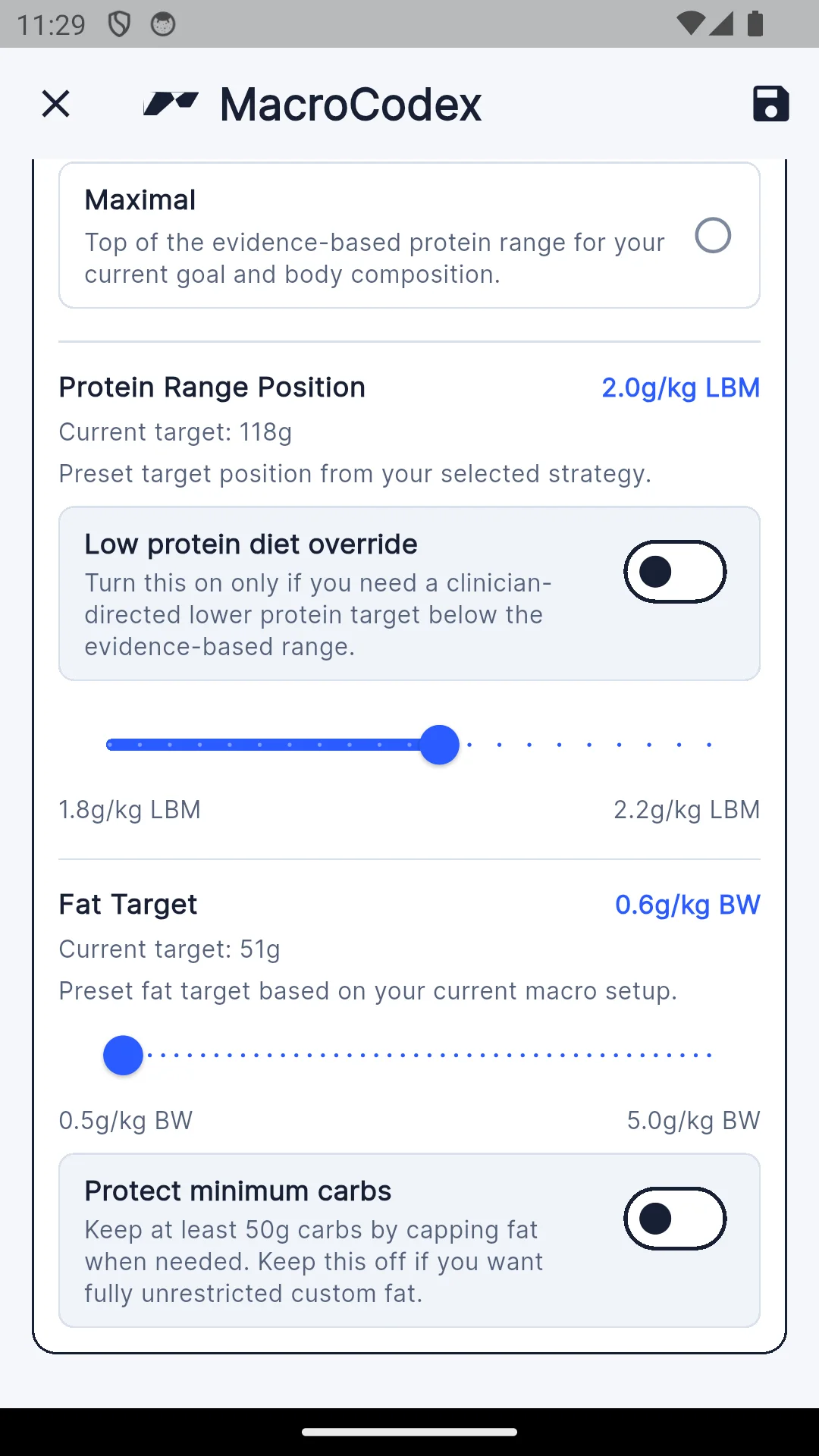
MacroCodex calculates daily protein needs from fat-free mass (FFM) or lean body mass (LBM) instead of total scale weight. When someone carries a significant amount of body fat, total bodyweight becomes a poor baseline.
To see why, look at standard sports nutrition targets. A commonly recommended range for resistance-trained individuals is 1.6 to 2.1 g of protein per kilogram of bodyweight. Apply that formula to an obese man who stands 180 cm tall and weighs 300 lb (136 kg), and you get an intake of 218 to 286 g of protein every day.
Most of that surplus mass does not require anywhere near that much nutritional upkeep. To put numbers to it, assume he has a fat-free mass index (FFMI) of 20. At 180 cm, that works out to roughly 64.8 kg of fat-free mass, meaning he carries about 52% body fat.
When you scale intake to lean mass instead, the picture changes entirely. In resistance-trained athletes cutting weight, published research frequently points to 2.3 to 3.1 g/kg of FFM. For standard weight loss, a range of 1.8 to 2.2 g/kg of LBM offers a practical target.
For 64.8 kg of LBM, the math looks like this:
- Cut target (2.3 to 3.1 g/kg LBM): approximately 149 to 201 g protein/day
- Weight loss target (1.8 to 2.2 g/kg LBM): approximately 117 to 143 g protein/day
These calculations land on a far more realistic figure than simply running a 136 kg frame through an athlete multiplier. The underlying reason is straightforward: dietary protein exists primarily to build and preserve protein-containing tissues, especially skeletal muscle. Lean tissue mass varies wildly across individuals who share the exact same scale weight. A 136 kg person carrying substantial body fat does not have the protein demands of a 136 kg lean athlete.
Scaling protein to FFM and LBM keeps high body fat from artificially driving up daily intake targets. At the same time, it accurately accounts for the metabolically active, protein-dependent tissue that actually needs maintenance.
The reverse holds true as well. When someone gets leaner at the same scale weight, their protein target can go up because a larger share of their total weight consists of lean mass.
None of this means a single protein-to-LBM ratio works as a universal formula. Actual needs depend on training status, the size of the caloric deficit, body fat levels, the rate of weight loss, age, and individual context. The 2.3 to 3.1 g/kg FFM bracket, for instance, comes straight from research on lean, resistance-trained people dieting under hypocaloric conditions. It was never meant as a blanket recommendation for everyone.
Recent literature on obesity reaches the same conclusion: relying on actual bodyweight can substantially overestimate daily protein needs. In these cases, estimated FFM, adjusted bodyweight, or target bodyweight serve as far more appropriate reference points.
A quick note on terminology: while people often treat lean body mass (LBM) and fat-free mass (FFM) as interchangeable terms, they carry a slight technical difference.
- Fat-free mass (FFM): Total body weight minus all fat tissue, including muscle, bone, internal organs, and essential fats.
- Lean body mass (LBM): Originally defined to include essential fats, whereas FFM excluded them. Because measuring essential fat in living subjects is notoriously difficult, both terms are routinely used to mean the same thing in practical settings.
Body composition research tends to rely on FFM simply because it is easier to quantify.
Directly Supported Ranges
These are the ranges most directly supported by the literature we cite.
| Goal | Protein Intake | Equivalent in Pounds | Source Info |
|---|---|---|---|
| Lean Bulk | 1.6-2.2 g/kg of Total Body Weight per day | 0.73-1.00 g/lb of body weight per day | Morton et al., 2018 (Br J Sports Med) found gains plateau around ~1.6 g/kg/day, with an upper 95% CI of ~2.2 g/kg/day. Schoenfeld & Aragon, 2018 (J Int Soc Sports Nutr) also present 1.6 g/kg/day as a practical minimum and 2.2 g/kg/day as a reasonable upper bound for maximizing muscle gain. |
| Bodybuilding Cut | 2.3-3.1 g/kg of Lean Body Mass (LBM) per day | 1.04-1.41 g/lb of LBM per day | Helms et al., 2014 (J Int Soc Sports Nutr) directly recommends 2.3-3.1 g/kg of LBM for bodybuilders dieting in a caloric deficit. Barakat et al., 2022 (Nutrients) supports high protein during aggressive cuts, while noting diminishing returns at the upper end. |
Practical Synthesis Ranges
These are coaching ranges inferred from the broader evidence and from how different dieting contexts change protein needs. They are useful, but they are not all direct quotes from one study.
| Goal | Protein Intake | Equivalent in Pounds | Evidence Basis |
|---|---|---|---|
| Body Recomp | 2.0-2.5 g/kg of Lean Body Mass (LBM) per day | 0.91-1.13 g/lb of LBM per day | Practical middle ground between muscle-gain research and deficit-focused research. Informed by Morton et al., 2018; Schoenfeld & Aragon, 2018; and Longland et al., 2016. |
| Weight Loss | 1.8-2.2 g/kg of Lean Body Mass (LBM) per day | 0.82-1.00 g/lb of LBM per day | Practical LBM-based range for general fat loss, especially in people with higher body fat where total body weight can overestimate needs. Informed by Morton et al., 2018; Longland et al., 2016; Wycherley et al., 2012; and Phillips et al., 2016. |
| Underweight Bulk | 1.6-2.2 g/kg of Total Body Weight per day | 0.73-1.00 g/lb of body weight per day | Best matched to the broader hypertrophy literature from Morton et al., 2018 and Schoenfeld & Aragon, 2018. In practice, a calorie based protein floor can still be useful for very light individuals so intake does not drift too low in absolute grams. |
If you want the most literal reading of the evidence, lean bulk is best expressed using total body weight, while bodybuilding cut is the clearest case for LBM based protein targets. The other rows are best treated as practical interpretations rather than exact study-derived ranges.
We've integrated all these complex factors into a mathematical model to build our Energy Macro Planner. The tool does the hard work for you, giving you the exact protein intake you need based on your personal stats and fitness goals.
Next Level
Now, all this is available in MacroCodex (ad free, no paywall, no payment)